What Built a 236? Alpha Viking Hall of Fame & Trait Analysis™
By
Heidi
Inside the pedigree behind the second-highest score in NRHA history.
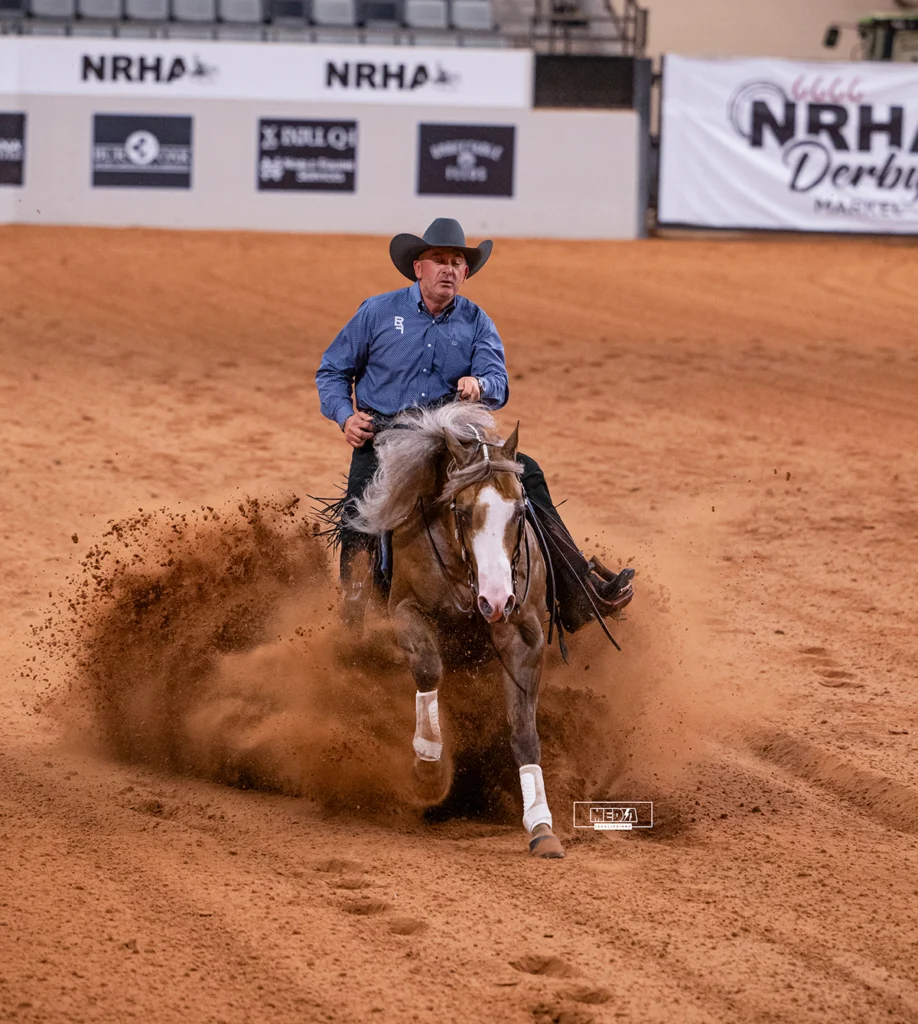
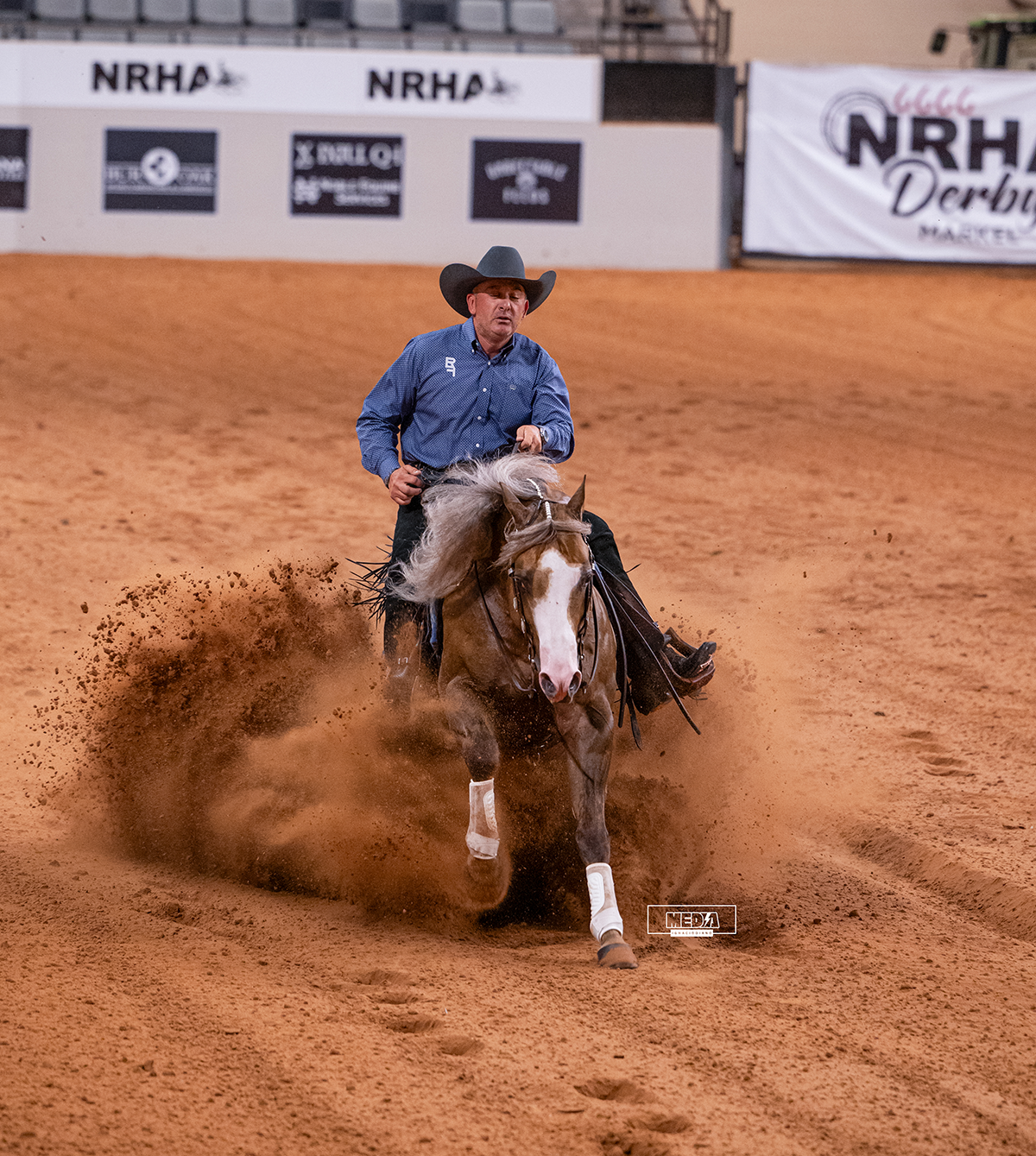
Every once in a while, a horse walks into the show pen and reminds everyone why this industry loves great horses. Alpha Viking did exactly that at the 2026 NRHA Derby. With Andrea Fappani in the saddle, the 2021 AQHA palomino stallion by Gunnatrashya out of Rock It With Sass marked a 236 to win the NRHA Level 4 Open Derby Championship, the highest score ever recorded in the NRHA Derby Finals and the second-highest score in NRHA history. Earlier that season, he also earned NRBC Reserve Champion honors, giving him one of the strongest 2026 campaigns of any young reining stallion.
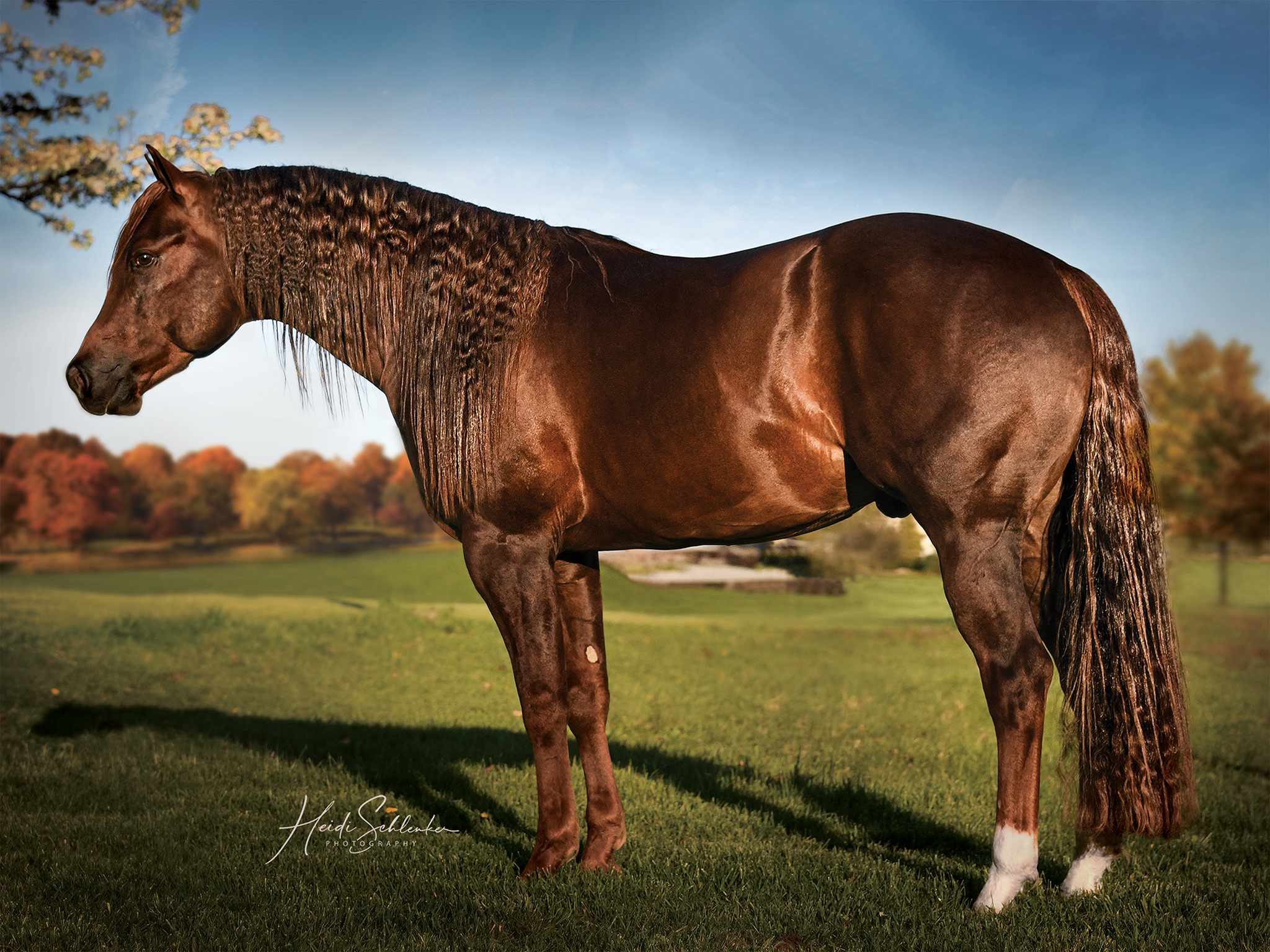
Alpha Viking has already earned $193,367, with $168,284 coming in 2026 under the Fappani program. Bred by Alpha Quarter Horses and owned by Alpha Quarter Horses and Vargo Quarter Horses, his story began with Gabriel Diano, who started and showed him before the stallion entered Andrea Fappani’s program. That progression matters because a performance record tells us what a horse accomplished, while a pedigree analysis helps explain why the horse may have been capable of producing that performance and what he may be positioned to transmit.
That is where the Quarternicks Hall of Fame & Trait Analysis™ begins. This analysis does not simply list famous names in a pedigree. It measures how AQHA Hall of Fame influence is distributed, reinforced, and transmitted throughout the pedigree, using updated AQHA Hall of Fame data through 2025. In Alpha Viking’s case, the performance created the question, but the pedigree provides the structure necessary to begin answering it. What built a 236 is not one ancestor, one trainer, one sire line, or one mare family. It is the way those influences are arranged, reinforced, and carried forward through the pedigree.
His complete Hall of Fame & Trait Analysis™ is available in the flipbook below. This article covers the key metrics and trait highlights. For the complete structural breakdown, including Hall of Fame occurrences across twenty generations, duplicated ancestor mechanics, family complexes, Colt and Filly Factor classifications, and the full Breeder Takeaway, read the complete report.
Stallion Profile
Name
Alpha Viking
Year
2021
Breed
AQHA
Color
Palomino
Sex
Stallion
Sire
Gunnatrashya
Dam
Rock It With Sass
Breeder
Alpha Quarter Horses
Owner
Alpha Quarter Horses and Vargo Quarter Horses
Analysis Date
July 2026
More Than a Derby Champion
A score of 236 is enough to make any breeder pay attention, but the score itself is only the surface. Alpha Viking’s record-setting Derby run showed speed, balance, rate, stop, turn, and mental composure under the pressure of one of the largest stages in reining. Those traits are visible in the show pen, but they do not originate there. They are trained, shaped, and polished by a program, but the raw material comes from the horse’s genetic architecture.
Alpha Viking’s sire, Gunnatrashya, has become one of the defining sires of modern reining. His influence is associated with explosive athletic ability, stopping power, maneuverability, and trainability, all traits that Alpha Viking displayed in his 2026 season. However, reducing Alpha Viking to “a son of Gunnatrashya” misses the more important pedigree question. The stallion’s maternal side contributes a female family with its own performance record, production record, and Hall of Fame structure.
Rock It With Sass, Alpha Viking’s dam, is a 2016 mare by Wimpys Little Step out of Shining N Sassy. She was shown by Gabriel Diano, earned $5,142, and is owned by Alpha Quarter Horses. She was bred by Roxanne Koepsell and sold to Alpha Quarter Horses as a yearling. Alpha Viking is her oldest foal to show, which makes his record significant not only as a performance achievement but also as an early indicator of what this young mare may contribute as a producer.
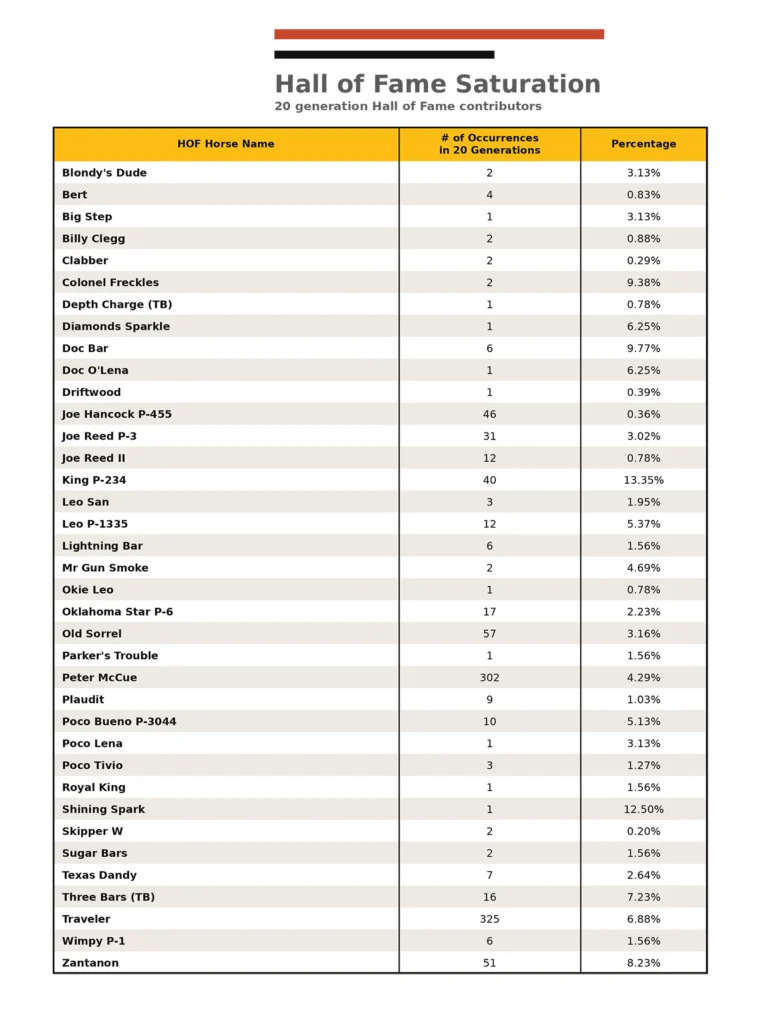
The second dam, Shining N Sassy, adds another layer. Bred and originally owned by Carol Rose, Shining N Sassy won the 2008 Reining Futurity with Tim McQuay, earned $232,672, and has produced more than $359,000. She was later purchased by Roxanne Koepsell. Through Shining N Sassy, Alpha Viking carries Shining Spark close in the pedigree, and that matters because Shining Spark becomes the single highest-percentage Hall of Fame contributor in the Alpha Viking analysis due to his generation-three position on the dam’s side.
This is the point where the Hall of Fame & Trait Analysis™ becomes necessary. A standard pedigree write-up can identify Gunnatrashya, Wimpys Little Step, Rock It With Sass, and Shining N Sassy. The Quarternicks analysis asks what those names are sitting on structurally, how much Hall of Fame influence exists behind them, whether that influence is broad or narrow, whether reinforcement is close or deep, and what trait categories the pedigree is most consistently built to support.
How Deep Are the Hall of Fame Bloodlines in Alpha Viking?
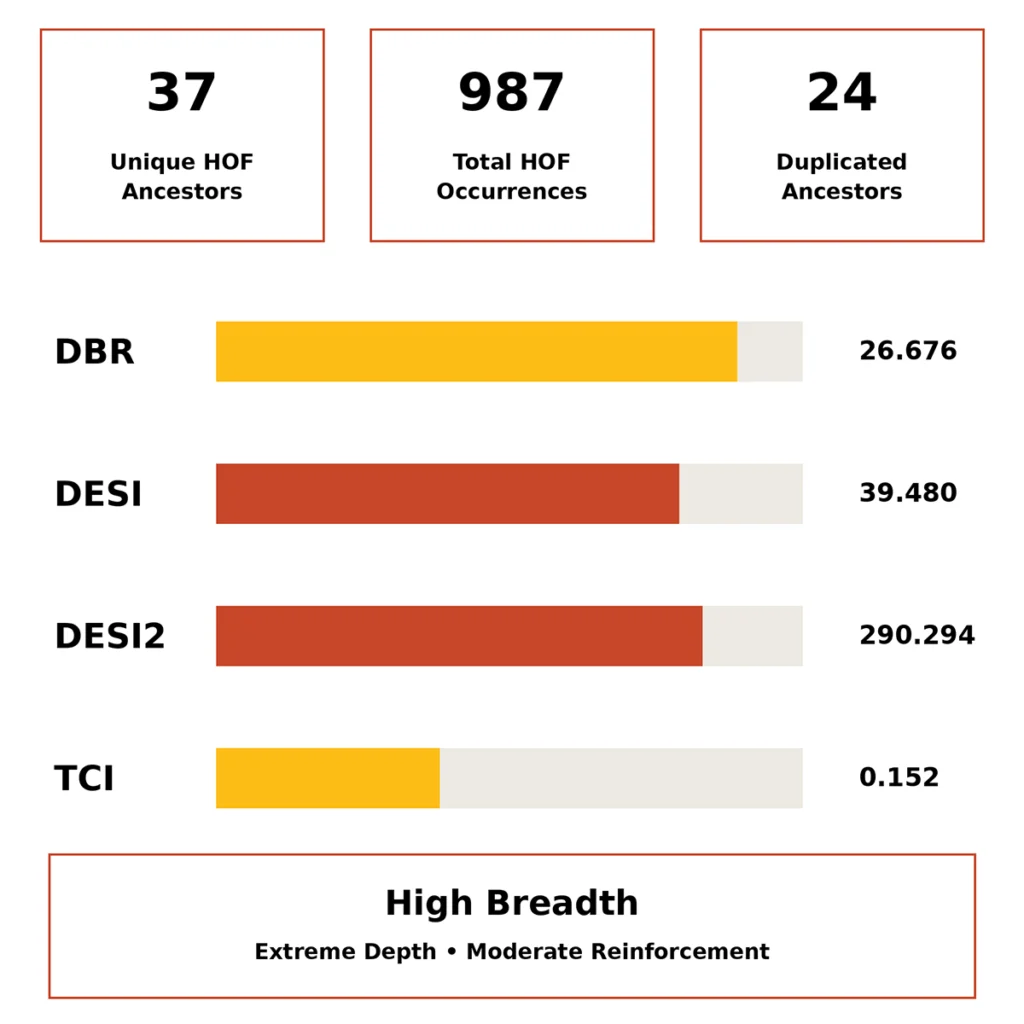
Alpha Viking carries 37 unique AQHA Hall of Fame ancestors across twenty generations and 987 total Hall of Fame occurrences. Those figures place him in the High Breadth and Extreme Depth tiers within the Quarternicks framework. Breadth measures how many distinct Hall of Fame contributors are represented, while depth measures how often those contributors recur throughout the pedigree. Alpha Viking sits at the ceiling of the High Breadth tier, one ancestor below the Very High threshold, while his occurrence total places him firmly in the Extreme Depth tier.
The distinction between breadth and depth is central to understanding this pedigree. A pedigree can contain many different elite ancestors without repeating them heavily, or it can repeat a smaller group of ancestors many times. Alpha Viking does both at a high level. The 37 unique Hall of Fame ancestors show that the pedigree draws from a wide benchmark pool, while the 987 total occurrences show that the same foundation influences have been reinforced repeatedly across the deeper generations.
The report identifies Alpha Viking as a reservoir-dominant pedigree. That means the saturation signal comes primarily from deep multi-generation accumulation rather than close-range compression. In practical terms, the pedigree is not built by stacking the same few close ancestors immediately behind the horse. Instead, the deeper pedigree carries a large reservoir of Hall of Fame influence that supports the close-generation performance horses.
Supporting Indices
The supporting indices reinforce what the Hall of Fame saturation metrics already suggest. Alpha Viking’s Depth-to-Breadth Ratio (DBR) of 26.68 tells us that his 987 Hall of Fame occurrences are generated from only 37 unique Hall of Fame contributors. That degree of repetition is characteristic of pedigrees built through generations of carefully recycled foundation bloodlines rather than aggressive close linebreeding. The numbers indicate that the pedigree derives its strength from repeated reinforcement of proven ancestors over time instead of depending on a handful of recent duplications.
The DESI2 value of 290.29 further supports that conclusion. Within the Quarternicks methodology, DESI2 adjusts for early duplication pressure and confirms that the saturation signal persists independently of how much early reinforcement is present. Alpha Viking falls comfortably within the Extreme category, confirming that his pedigree is built on deep multi-generation accumulation rather than engineered close-range linebreeding.
What Traits Does Alpha Viking Carry?
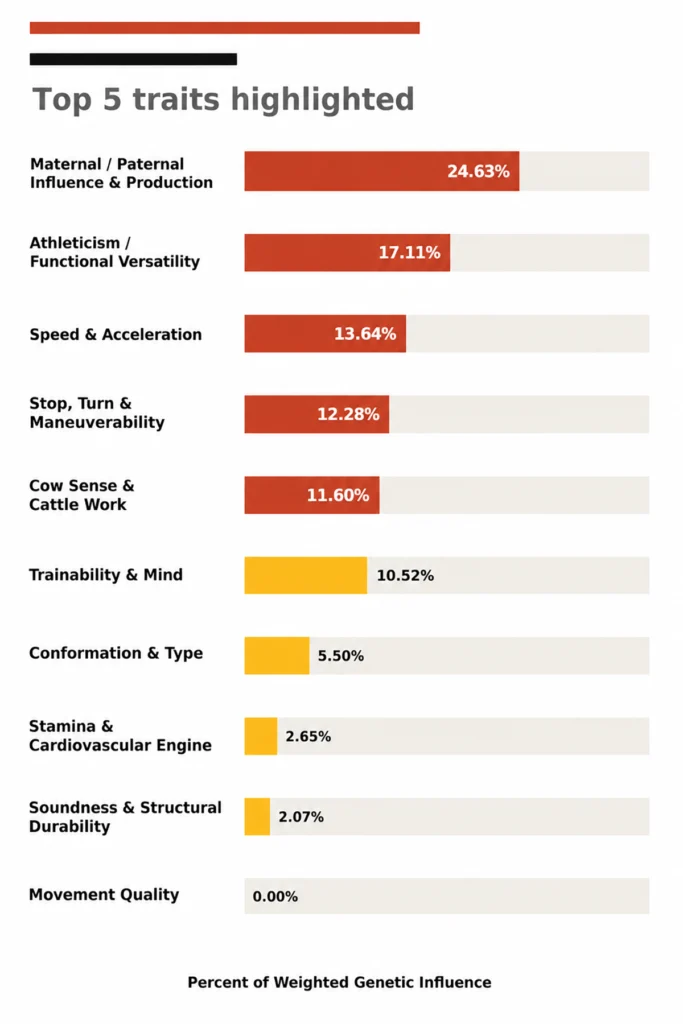
The Hall of Fame-weighted trait profile reflects that broad distribution. Maternal and Paternal Influence and Production lead the analysis at 24.63%, followed by Athleticism and Functional Versatility at 17.11%, Speed and Acceleration at 13.64%, Stop, Turn and Maneuverability at 12.28%, Cow Sense and Cattle Work at 11.60%, and Trainability and Mind at 10.52%. Together, those six categories account for nearly ninety percent of Alpha Viking’s total Hall of Fame-weighted trait signal.
The production signal is built from breadth rather than dominance by a single contributor. King P-234 drives the largest individual share through forty occurrences, while Doc Bar, Leo, Lightning Bar, Joe Reed P-3, Joe Reed II, Texas Dandy, Oklahoma Star P-6, and Old Sorrel add smaller but cumulative primary-role weights. The result is a production category assembled from many contributors rather than one dominant name.
Athleticism and Functional Versatility emerge as the second strongest category, reflecting a pedigree capable of supporting multiple western performance disciplines rather than a narrow specialization. Speed and Acceleration follow closely, reinforced through the Three Bars family and generations of performance breeding that emphasized impulsion and responsiveness. Stop, Turn and Maneuverability receive substantial support from the modern reining influences in the close pedigree, while Cow Sense and Cattle Work remain firmly represented through the Doc Bar, Poco Bueno, Poco Tivio, Colonel Freckles, and Doc O’Lena families.
Perhaps the most interesting observation is that no single trait category dominates the pedigree. Rather than concentrating its Hall of Fame signal into a single performance lane, Alpha Viking’s pedigree distributes influence across production, athleticism, speed, stop, maneuverability, cow horse ability, and trainability. That balanced distribution suggests a stallion capable of transmitting multiple functional traits instead of a narrow specialization.
Those numbers align closely with what breeders observe in the show pen. Alpha Viking demonstrates exceptional athleticism without sacrificing trainability. His speed remains controlled through balanced body position. His stops are powerful without becoming disconnected from cadence or rhythm. His spins remain level, and his willingness throughout each maneuver reflects a pedigree carrying substantial trainability alongside athletic ability. The Hall of Fame metrics do not replace those observations. They help explain why those traits appear together.
The Alpha Viking Pedigree Close-Up
Despite carrying twenty-four duplicated ancestors within eight generations, Alpha Viking’s coefficient of inbreeding measures only 1.7323%. Eighteen of those duplicated ancestors are true linebreedings, appearing on both the sire’s and dam’s side of the pedigree and contributing to the coefficient of inbreeding. The remaining six are one-sided concentrations that reinforce individual family lines without creating additional cross-pedigree inbreeding pressure. Because most of the linebreedings occur in generations seven and eight, their individual contribution to measured inbreeding remains small.
One of the defining structural characteristics of Alpha Viking’s pedigree is the relationship between the close pedigree and the deep pedigree reservoir. The close generations contain the horses most breeders immediately recognize, including Gunnatrashya, Wimpys Little Step, and Shining Spark. Those horses provide the immediate performance architecture visible within the first few generations. The deeper pedigree tells a different story. Traveler, Peter McCue, King, Old Sorrel, Zantanon, and numerous additional Hall of Fame ancestors continue reinforcing the same functional traits across twenty generations, producing one of the deepest Hall of Fame reservoirs in the Quarternicks database.
Shining Spark deserves particular attention because of his structural position within the pedigree. Although he appears only once, his generation-three placement gives him the highest weighted Hall of Fame contribution in the entire analysis. That illustrates an important principle within the Quarternicks methodology. The number of appearances alone does not determine influence. Position within the pedigree matters just as much because closer generations carry greater weighting than distant ones.
The combination of Gunnatrashya’s modern reining influence, the proven female family descending from Shining N Sassy, and the extensive Hall of Fame reservoir beneath both creates a pedigree whose structural strength extends well beyond the first four generations. That is precisely the type of architecture the Hall of Fame & Trait Analysis™ was designed to identify.
The complete Alpha Viking report explores Hall of Fame occurrences across all twenty generations, duplicated ancestor mechanics, family complexes, mapped reinforcement lanes, Colt and Filly Factor classifications, and the complete Breeder Takeaway. Those details are available in the flipbook below and provide the full structural analysis behind the summary presented here.
Colt & Filly Factor Summary
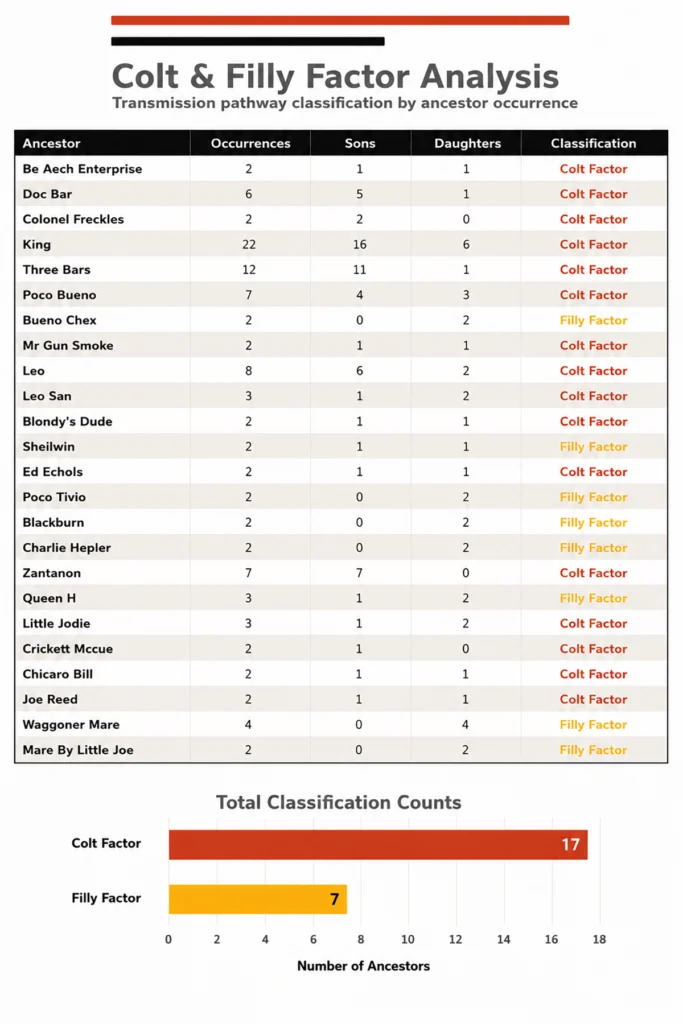
Alpha Viking’s close pedigree leans strongly toward sire-line transmission. Seventeen duplicated ancestors classify as Colt Factor, seven classify as Filly Factor, and none classify as Balanced. The Colt Factor dominance is concentrated in the pedigree’s largest occurrence ancestors, with King, Three Bars, Leo, Poco Bueno, Zantanon, and Doc Bar all classifying as Colt Factor and together accounting for most of the close-pedigree occurrences.
The Filly Factor signal is concentrated in a smaller group of female-line influences, including Bueno Chex, Sheilwin, Poco Tivio, Blackburn, Charlie Hepler, Queen H, Waggoner Mare, and Mare By Little Joe. Those ancestors provide production-side reinforcement within a pedigree that remains decisively weighted toward Colt Factor transmission. Together, the Colt and Filly Factor results show that Alpha Viking’s duplicated ancestor network is not evenly balanced. It is reservoir-dominant, deeply reinforced, and strongly oriented toward sire-line performance transmission.
Breeder Takeaway
Alpha Viking enters the breeding shed with something few young stallions possess: a performance record capable of attracting immediate attention and a pedigree capable of sustaining long-term interest. The 236 at the 2026 NRHA Derby demonstrated elite athletic ability under the highest level of competition, but the Hall of Fame & Trait Analysis™ suggests that performance is supported by a pedigree built on structural depth rather than isolated brilliance.
The combination of High Breadth, Extreme Depth, Moderate early reinforcement, a Broadly Distributed Trait Concentration Index, and one of the strongest production signals in the Quarternicks database creates a pedigree that does not point toward a single dominant trait category. Instead, it reflects a reservoir-dominant functional profile supported by generations of reinforced Hall of Fame influence. For breeders, that distinction matters because the pedigree is positioned to contribute production, athleticism, speed, maneuverability, cow horse ability, and trainability while carrying a strong Colt Factor lean in the duplicated ancestor network.
The maternal side deserves particular recognition. While Gunnatrashya understandably receives much of the attention, Rock It With Sass and the Shining N Sassy family contribute a proven female line that complements the sire line exceptionally well. Shining N Sassy’s own performance record, combined with her production history, strengthens the pedigree in ways that extend beyond a single Hall of Fame ancestor. Within the Quarternicks framework, that relationship between the modern close pedigree and the deep Hall of Fame reservoir is one of Alpha Viking’s defining structural characteristics.
As Alpha Viking’s foals begin entering the show pen, breeders will naturally evaluate whether his extraordinary athletic ability is being reproduced. The Hall of Fame & Trait Analysis™ does not predict future earnings or guarantee performance outcomes, but it does provide an objective framework for understanding the genetic architecture supporting those expectations. In Alpha Viking’s case, that framework identifies a pedigree with exceptional Hall of Fame saturation, balanced trait distribution, and reinforcement patterns consistent with a stallion capable of transmitting a broad range of functional performance characteristics.
Final Thoughts
Some horses earn headlines because of one unforgettable performance. Others become influential because their pedigrees continue producing long after their own show careers have ended. Alpha Viking has already achieved the first milestone. Whether he ultimately reaches the second will depend on the horses he leaves behind.
His Hall of Fame & Trait Analysis™ suggests that breeders have good reason to pay attention. Beneath the historic 236 lies a pedigree carrying 987 Hall of Fame occurrences across twenty generations, reinforced by thirty-seven unique Hall of Fame ancestors and distributed across one of the most balanced functional trait profiles we have analyzed. Those numbers do not explain every great run, but they do help explain why Alpha Viking’s pedigree deserves the same level of attention as his accomplishments in the show pen.
Disclaimer
This analysis is part of the Quarternicks Hall of Fame & Trait Analysis™ series. The methodology builds on the framework developed by Susan Larkin and uses updated AQHA Hall of Fame data through 2025. Results represent pedigree structure and genetic tendency, not a guarantee of individual performance outcomes. All breeding decisions should be evaluated alongside conformation, soundness, and the breeder’s specific goals.
What Makes a Pedigree More Than Just a Name List? In the realm of horse breeding, Adios Pantalones represents a key concept that enthusiasts should not overlook. Outcrossing! When a horseman looks at a pedigree, they see names. When a geneticist looks at the same pedigree, they see probability. The Quarternicks Hall of Fame and […]
Inbreeding and linebreeding in horses refer to the concentration of shared ancestry within a pedigree to reinforce genetic influence. While inbreeding focuses on closer duplications and linebreeding spreads influence across deeper generations, both strategies shape how traits are expressed, transmitted, and stabilized. Pedigree structure determines whether that concentration produces consistency or amplifies weaknesses.
Volturi's success is no accident. Bred by legendary horseman Bob Loomis and already a two-time National Champion, this exceptional son of Smoking Whiz carries one of the deepest Hall of Fame pedigrees we've analyzed. Discover how the Quarternicks Hall of Fame & Trait Analysis™ uncovers the pedigree structure, Hall of Fame saturation, and trait profile behind one of reining's most intriguing breeding stallions.
To provide the best experiences, we use technologies like cookies to store and/or access device information. Consenting to these technologies will allow us to process data such as browsing behavior or unique IDs on this site. Not consenting or withdrawing consent, may adversely affect certain features and functions.
Functional
Always active
The technical storage or access is strictly necessary for the legitimate purpose of enabling the use of a specific service explicitly requested by the subscriber or user, or for the sole purpose of carrying out the transmission of a communication over an electronic communications network.
Preferences
The technical storage or access is necessary for the legitimate purpose of storing preferences that are not requested by the subscriber or user.
Statistics
The technical storage or access that is used exclusively for statistical purposes.The technical storage or access that is used exclusively for anonymous statistical purposes. Without a subpoena, voluntary compliance on the part of your Internet Service Provider, or additional records from a third party, information stored or retrieved for this purpose alone cannot usually be used to identify you.
Marketing
The technical storage or access is required to create user profiles to send advertising, or to track the user on a website or across several websites for similar marketing purposes.