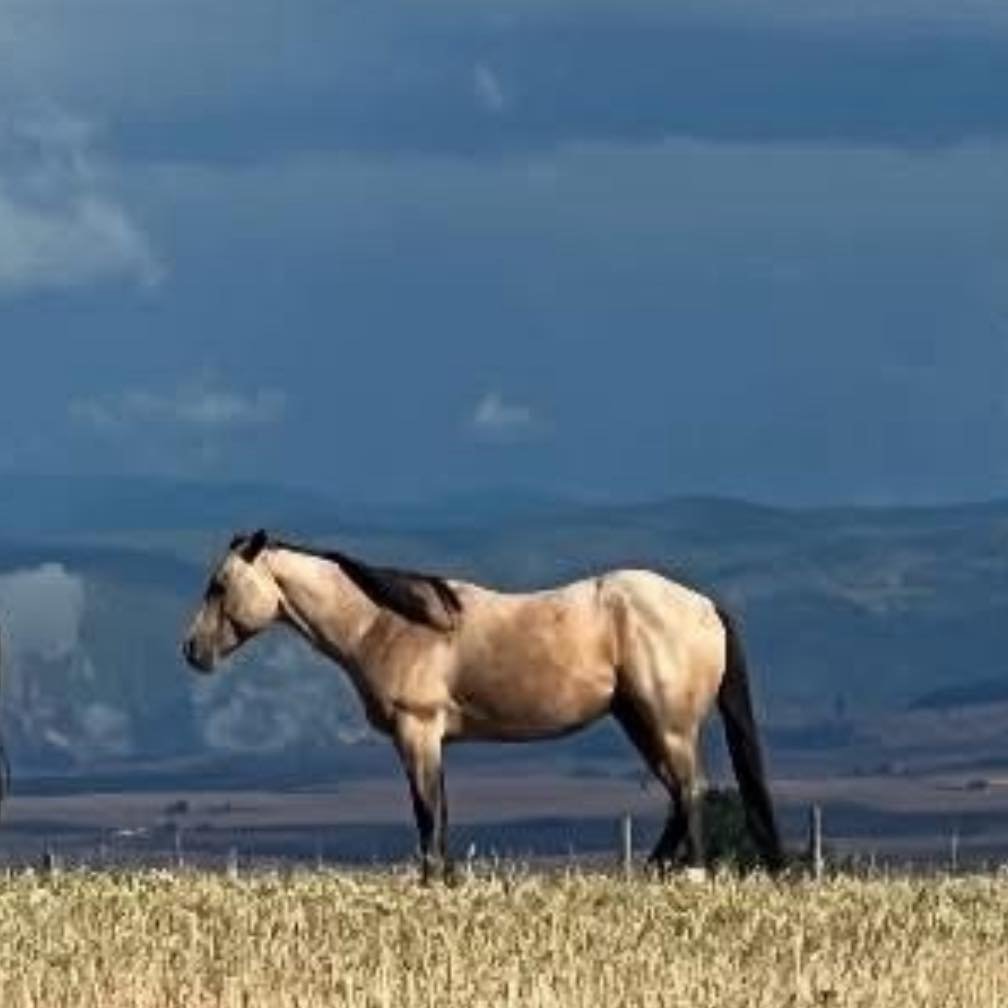
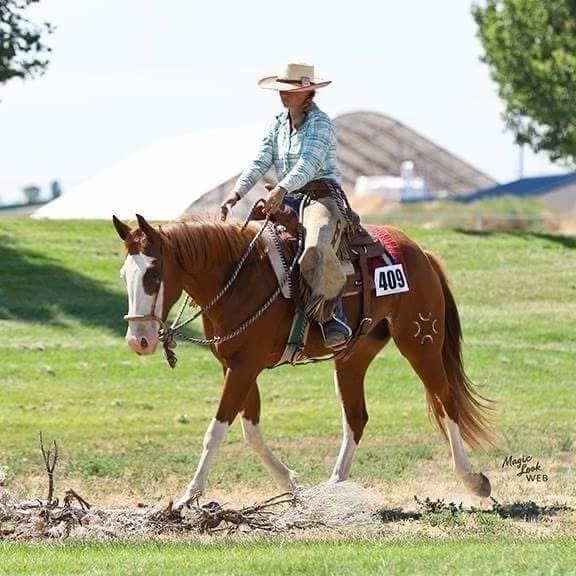
WELCOME TO QUARTERNICKS

Home of the Hall of Fame and Trait Analysis™

Premier Quarter Horse Pedigree Analysis and nicking intelligence for Quarter Horse and Paint breeders

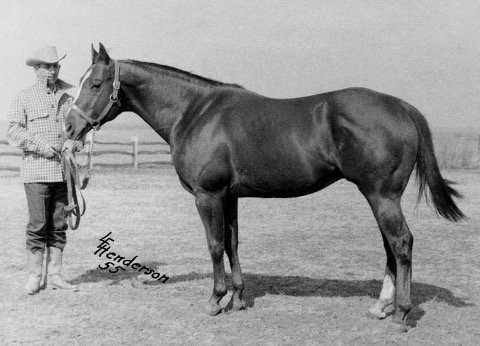
Sugar Bars, a prominent Quarter Horse, with handler at age 4

Quarter and Paint Horse Pedigree Analysis
and Breeding Compatibility

What Quarternicks Does

Quarternicks provides Paint and Quarter Horse pedigree analysis and breeding compatibility evaluation designed specifically for Quarter Horse and Paint Horse performance breeders. The system examines how pedigree influence, structural conformation, and trait transmission interact when two horses are crossed.

A pedigree represents far more than a list of names. It reflects patterns of influence created by ancestors that consistently transmitted specific traits such as athletic ability, structural durability, trainability, and discipline aptitude. When these patterns are studied across multiple generations, they reveal how traits are reinforced or diluted within a breeding program.

QuarterNicks analyzes these patterns through structured pedigree research combined with score based conformation evaluation. This allows breeders to see how pedigree influence and physical structure work together to shape the type of horse a mating is most likely to produce.

The goal is not simply to identify popular crosses. The goal is to identify crosses that are structurally and genetically compatible.

No more limits

The Limitations of Traditional Nicking Reports

Many breeding “nicking reports” within the horse industry rely primarily on earnings records of past crosses. These systems typically list which broodmare sire lines have produced money earners when crossed with a particular stallion.

While this information can highlight historical patterns, it does not necessarily reveal why those crosses succeeded or whether they are genetically compatible for a specific mare.

Earnings based nicking reports often overlook several critical factors.

They do not adjust for population size. Stallions that bred large books of mares will naturally produce more winners simply because they had more opportunities.

They do not evaluate pedigree structure. Simply listing a broodmare sire does not show how influential ancestors are placed within the pedigree or how those influences interact.

They do not consider structural compatibility. Two horses may share successful ancestors while still reinforcing the same physical weaknesses.

They do not account for trait transmission. Performance traits such as speed, cow sense, durability, or trainability are influenced by complex pedigree patterns that cannot be measured by earnings alone.

Because of these limitations, many traditional nicking reports are descriptive rather than predictive.

20 Generation Pedigree Analysis
QuarterNicks examines the deeper architecture of a pedigree across twenty generations to identify how influential ancestors are distributed, repeated, and reinforced. This analysis tracks the occurrence and duplication of AQHA Hall of Fame horses, evaluates linebreeding patterns, and measures how influential bloodlines concentrate through sire lines, dam lines, and maternal families. By examining these deeper pedigree structures, breeders gain insight into how performance traits accumulate and which influences are most likely to shape the next generation.
Order Pedigree Analysis
Scored Conformation Analysis
Pedigree influence explains part of the horse. Structural design determines whether that genetic potential can function athletically. QuarterNicks evaluates conformation through a structured scoring system based on the Quarter Horse breed standard ideal. Each horse is analyzed section by section to identify strengths, weaknesses, and biomechanical considerations that may affect performance, durability, and long-term soundness. This allows breeders to evaluate whether a proposed mating improves structural balance rather than reinforcing the same physical faults.
Order Conformation Analysis
Nicking Strategy Analysis
The final stage applies the pedigree and conformation analysis to real breeding decisions. QuarterNicks evaluates how a mare’s pedigree architecture, trait profile, and structural design interact with potential stallion matches. The analysis compares multiple stallions to determine which crosses reinforce desirable traits, improve structural balance, and support the production of the intended type of performance horse. Rather than relying solely on historical nicking statistics, this approach evaluates the biological compatibility of the mating and ranks stallion options based on pedigree structure, trait alignment, and conformation compatibility.
View Nicking Packages
STOP RELYING ON FADS AND RELY ON WHAT WORKS INSTEAD

Compatibility Based Breeding Analysis

Quarternicks incorporates traditional breeding data, but it does not rely on it as the sole explanation for why a cross succeeds. Historical performance records, production statistics, broodmare sire patterns, and discipline specific earnings all provide valuable information about what certain bloodlines have already accomplished. Those indicators help establish historical context, but they do not fully explain the biological reason a mating works or whether the same result is likely to occur again.

For that reason, Quarternicks moves beyond surface statistics and examines the deeper architecture of the pedigree itself. The analysis evaluates how influential ancestors are distributed across the mating, how frequently they repeat, and whether those repetitions occur through meaningful structural patterns. This includes examining inbreeding and linebreeding structures, the placement of influential ancestors across multiple generations, pathway balance between sire and dam lines, and the contribution of maternal families to the overall strength of the pedigree.

Potent pedigree patterns often occur several generations back and appear through multiple independent pathways. Identifying those patterns requires tracking how influential ancestors repeat through sons, daughters, and maternal families, determining whether those repetitions create purposeful linebreeding or simply accidental duplication, and evaluating whether those repetitions concentrate the traits that made those ancestors influential in the first place. This also requires determining whether repeated pathways build enough reinforcement to create critical mass around a trait package or whether the pedigree only carries scattered influence without enough concentration to reproduce that trait consistently.

The pathways through which ancestors appear can also change how their influence functions. An ancestor that repeats through daughters may reinforce maternal traits very differently than that same ancestor appearing through sons. Colt and filly factors can also affect how certain patterns transmit, because reinforcement occurring through male or female pathways may influence how traits are expressed in the next generation. Relationships between full siblings, half siblings, three-quarter siblings, and seven-eighths siblings can further alter how these patterns interact within a pedigree.

These are not patterns that immediately jump off the page. They often require careful analysis across multiple generations to identify, and even more experience to interpret correctly. Even when those patterns are identified, the real challenge lies in understanding what they mean. Some inbreeding and linebreeding structures reinforce useful traits and create consistency in the type of athlete produced, while other patterns simply concentrate weaknesses or create pedigrees that appear impressive on paper but do not reproduce reliably.

Structural compatibility is also evaluated because breeding decisions must make sense physically as well as genetically. Two horses may both possess successful pedigrees while still representing a poor mating if their conformational tendencies reinforce the same structural weaknesses or fail to complement one another biomechanically. A pedigree may explain part of the horse, but the body must still be capable of carrying that genetic potential.

By combining historical performance information with pedigree architecture analysis, conformational evaluation, and discipline-specific interpretation, Quarternicks seeks to answer a more meaningful question than traditional nicking reports. Rather than simply identifying what crosses have worked before, the goal is to understand why they worked and whether there is a legitimate biological reason to expect similar results in the future.

QUANITIFIABLE, SCORED AND RANKED

How Quarternicks Evaluates Breeding Compatibility

Quarternicks evaluates breeding compatibility through multiple layers of structural, pedigree, and performance analysis. While pedigree architecture explains how performance traits accumulate across generations, the physical structure of the horse determines whether that genetic potential can function athletically. For that reason, conformational compatibility carries the greatest weight in the overall evaluation.

Structural Design & Conformation Compatibility
Conformation Analysis 40%
Pedigree Architecture and Genetic Reinforcement
Pedigree Analysis 35%
Stallion Compatibility Evaluation
Nicking the Stallion to the Mare 20%
Historical Performance Context
Earnings 5%
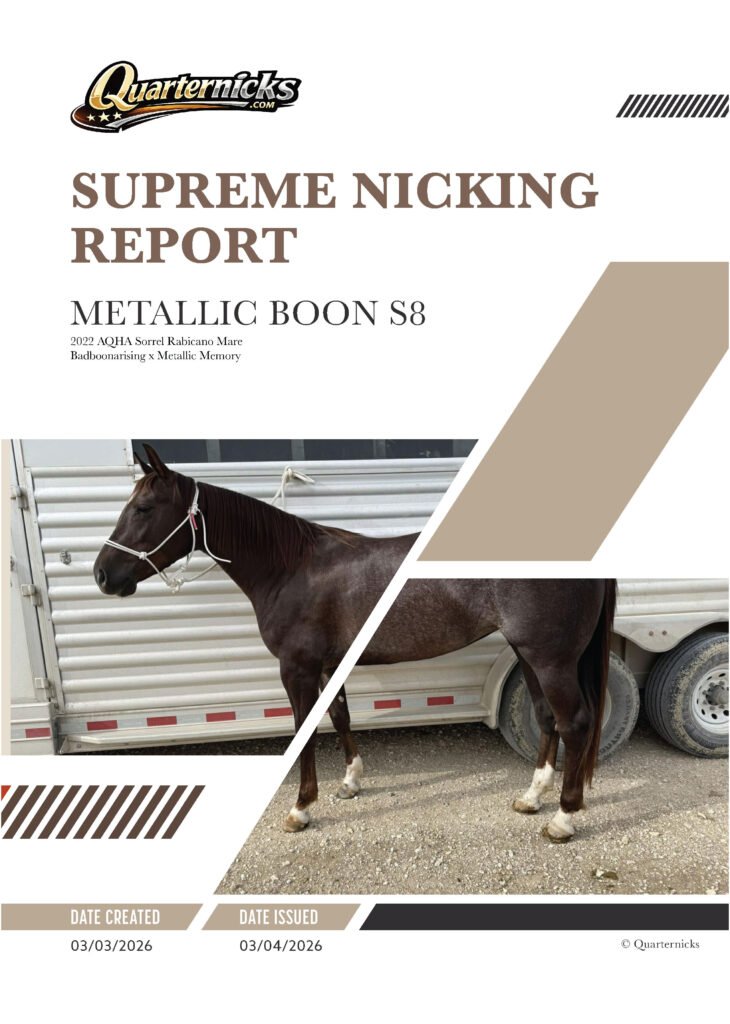
Quarternicks Supreme Nicking Report cover with text featuring horse's registered name, sire and dam, and a photo of the horse.
THE GOLD STANDARD
IN QUARTER AND PAINT HORSE NICKING

Quarternicks Nicking Reports

Quarternicks Nicking Reports apply the analytical framework described above directly to real breeding decisions. Each report combines pedigree architecture analysis, trait transmission evaluation, structural conformation assessment, and performance record context to determine which stallions are most compatible with a specific mare.

Rather than simply listing crosses that have produced money earners in the past, the analysis evaluates how the mare’s genetic structure and physical design interact with potential stallion matches. This allows the evaluation to move beyond surface statistics and focus on the biological compatibility of the mating.

The report begins by establishing a complete profile of the mare. This includes a twenty-generation pedigree analysis that evaluates the distribution and duplication of influential ancestors, patterns of linebreeding and inbreeding, and the concentration of traits that may influence performance ability. Conformation is then evaluated through a structured scoring system that identifies the mare’s physical strengths and weaknesses and highlights the areas where structural improvement may be beneficial.

Once the mare’s pedigree architecture, trait profile, and structural design are established, potential stallions are evaluated against those characteristics. Each recommended stallion is assessed for pedigree compatibility, trait alignment, structural complementarity, and discipline direction. When available, performance records and production statistics are also considered to provide real world context for the analysis.

The result is a ranked set of stallion recommendations supported by detailed reasoning for each match. Rather than relying on trends or marketing narratives, breeders receive a structured explanation of why certain crosses reinforce desirable traits while others may introduce unnecessary risk.

Quarternicks Nicking Reports are designed to give breeders a clearer understanding of how a mating is likely to function before the breeding decision is made.

COMPREHENSIVE REPORTS THAT MAKE NICKING SIMPLE AND RELIABLE

AVAILABLE REPORTS

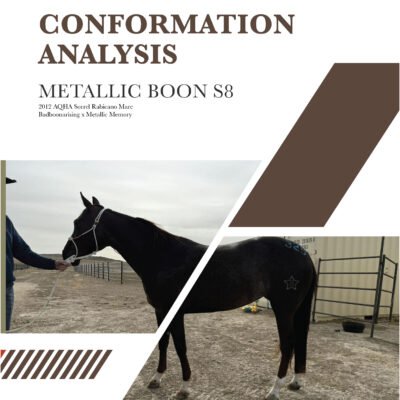
Quarternicks Conformation Analysis Cover page featuring text of horse's registered name, sire and dam, and a photo of the horse.
Most Popular
Quarternicks Conformation Analysis
Original price was: $150.00.Current price is: $0.00.
QuarterNicks Conformation Analysis provides breeders with a detailed structural evaluation...
placeholder
Most Popular
Expedite My Report Add-on
Original price was: $150.00.Current price is: $0.00.
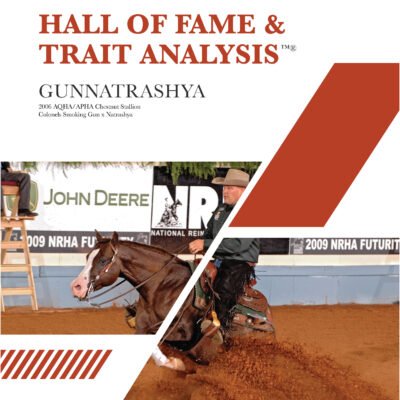
Quarternicks Hall of Fame and Trait Analysis™ cover featuring horse's registered name, sire and dam, and photo of the horse.
Hall of Fame and Trait Analysis™
$250.00
The QuarterNicks Hall of Fame and Trait Analysis®™ provides a...
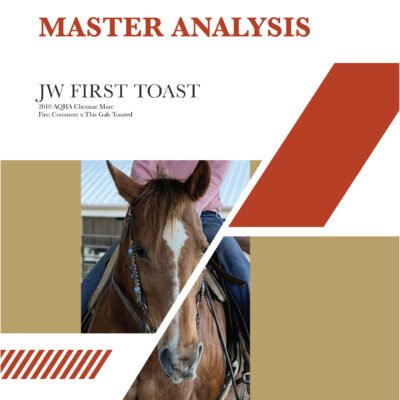
Quarternicks Master Analysis Report cover with text featuring horse's registered name, sire and dam, and a photo of the horse.
Quarternicks Master Analysis
$350.00
The QuarterNicks Master Analysis combines deep pedigree research with a...
Quarter Horse pedigree analysis
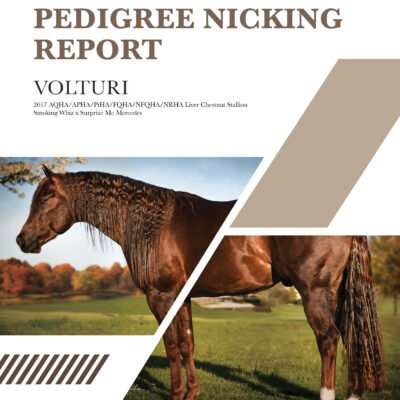
Quarternicks Pedigree Nicking Report
$499.00
The QuarterNicks Pedigree Nicking Report evaluates how a mare’s pedigree...
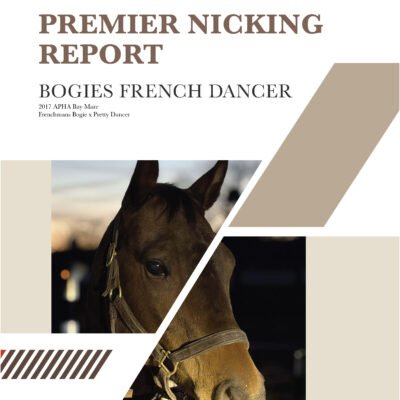
Quarternicks Premier Nicking Report cover with text featuring horse's registered name, sire and dam, and a photo of the horse.
Quarternicks Premier Nicking Report
$699.00
The QuarterNicks Premier Nicking Report combines deep pedigree analysis, structural...

DESIGNED FOR

Breeders Ready to Take Their Program to the Next Level

Quarternicks was built for breeders who want to make deliberate breeding decisions rather than simply following popular crosses. Performance horse breeding has become increasingly complex as reproductive technology, incentive programs, and rapidly shifting sire trends influence the marketplace.

The system is designed for breeders who want to understand how pedigree structure and physical design interact before making a mating decision. It is equally valuable for experienced breeding programs refining long-term bloodline strategy and for newer breeders who want to avoid costly trial and error when selecting stallions.

Quarternicks is used by breeders across multiple performance sectors including reining, cow horse, cutting, roping, ranch events, and versatility competition. While each discipline emphasizes different traits, the underlying genetic and structural principles that influence performance remain the same.

BREEDING IS AN INVESTMENT

See What Breeders are Saying About Quarternicks

How It Works

01

Submit your horse

After placing your order, you will provide a copy of the horse’s registration papers. If the report includes conformation analysis, you will also submit the required conformation photos. If you ordered a nicking report, you will be asked to supply your selection requirements for stallions.

02

Analysis begins

Depending on the report type you ordered, the horse’s pedigree architecture, trait transmission patterns, and structural characteristics are evaluated using the Quarternicks analytical framework.

03

Compatibility evaluation

If the report includes stallion compatibility, the mare is evaluated against the selected stallions to determine how each cross aligns genetically and structurally.

04

Report delivery

Your completed report is delivered digitally with a detailed explanation of the findings and breeding recommendations.

GOT QUESTIONS?

We've Got Answers

Breeders often have questions about how Quarternicks reports are prepared, what information is required, and how the analysis should be interpreted. The following answers address the most common questions about the QuarterNicks system and the process of ordering a report.

Pedigree analysis examines how genetic influence flows through a horse’s pedigree and how those influences affect athletic ability, trainability, and physical structure. By studying how influential ancestors repeat and interact across generations, breeders can better understand which traits are most likely to be transmitted to the next generation and how different bloodlines may complement each other.

Traditional nicking reports typically focus on historical earnings data from previous crosses. While that information can be useful, it only describes what has already happened and does not always explain why a cross produced successful horses.

Quarternicks goes further by evaluating pedigree architecture, trait transmission patterns, structural conformation compatibility, and discipline context. This allows breeders to understand the biological reasons a cross may work rather than relying only on historical production statistics.

The Hall of Fame and Trait Analysis™ report require a photo of the horse’s registration papers.

All other reports require a photo of the horse’s registration papers, and 4 quality conformation photos; left side profile, right side profile, front, and hind. Instructions for submitting photos are provided after purchase to ensure the analysis is accurate.

CONFORMATION PHOTO INSTRUCTIONS

GENERAL REQUIREMENTS
• The horse must be standing on level, even ground. Slopes, hills, or uneven footing will cause the horse to shift weight and distort how its structure appears in the photograph.
• The horse should be clean and properly groomed so that body lines and muscling are clearly visible.
• The horse should stand naturally and relaxed, with the head carried in a normal position rather than pulled up or stretched forward.
• All four hooves must be clearly visible in the photograph. Do not allow grass, bedding, mud, or shadows to hide the feet.
• Do not use the zoom function on a cell phone or camera. Digital zoom distorts proportions and can make limbs or body parts appear incorrectly shaped. If the horse does not fit in the frame, move farther away instead of zooming.

SIDE VIEW CONFORMATION PHOTO
• Position the horse so the side closest to the camera is clearly visible.
• The hind limb closest to the camera should be placed so that it forms a straight plumb line from the top of the tail head, through the cannon bone, to the back of the heel.
• The hind limb on the far side (off side hind leg) should be positioned slightly in front of the near hind leg.
• The forelimb closest to the camera should form a straight line from the wither to the elbow, through the cannon bone, down to the back of the heel.
• The forelimb on the far side (off side forelimb) should be positioned slightly behind the near forelimb.
• This positioning allows all four limbs to be visible while maintaining proper alignment for evaluating conformation.
• The photographer should kneel down when taking the photo and aim the camera toward the horse’s flank and slightly toward the barrel.
• Stand far enough away so the entire horse, from nose to tail, is visible in the frame without cropping any part of the body.

FRONT VIEW CONFORMATION PHOTO
• The horse should stand square with both front feet evenly placed beneath the body.
• Both hind feet should also be supporting the horse evenly so the horse is standing balanced and straight.
• The front limbs should be clearly visible and evenly spaced.
• The photographer should kneel down and stand far enough away to capture the entire horse in the photo.
• The camera should be centered directly in front of the horse so both sides of the body are evenly visible.
• Do not use the zoom function. Move closer or farther away as needed to frame the entire horse.


HIND VIEW CONFORMATION PHOTO
• The horse should stand square with equal weight placed on both hind legs.
• Both hind feet should be clearly visible and evenly positioned beneath the horse.
• The horse should stand straight so both sides of the hindquarters are visible.
• The photographer should kneel down and position themselves directly behind the horse, centered with the tail.
• Stand far enough away to capture the entire horse in the frame.
• The camera should be level and aimed straight toward the hindquarters so both sides of the horse are evenly visible.
• Do not use digital zoom. Move the camera position instead to properly frame the horse.

Yes. Quarternicks analysis is designed specifically for the Quarter Horse and Paint Horse industries. The system focuses on the influential bloodlines, performance traits, and pedigree patterns that are most relevant within these breeds.

No breeding analysis can guarantee a specific outcome. Pedigree and compatibility analysis identifies statistical probability and genetic likelihood based on pedigree structure, trait reinforcement, and conformational compatibility. While this greatly improves decision making, individual results can still vary due to genetics, training, and environmental factors.

Yes. Nicking reports evaluate how a mare’s pedigree and conformation interact with potential stallions. The analysis identifies stallions that are most compatible based on pedigree architecture, trait transmission patterns, structural balance, discipline direction, and historical performance data when available.

Yes. One important part of pedigree analysis is identifying where influential bloodlines are becoming too concentrated within the breed. Quarternicks analysis helps breeders identify meaningful outcross opportunities that maintain performance ability while restoring genetic balance.

Yes. New breeders often benefit the most from structured pedigree analysis because it helps avoid common breeding mistakes such as stacking the same weaknesses, unintentionally concentrating genetic bottlenecks, or choosing stallions based only on popularity.

Quarternicks reports are individually prepared and involve detailed pedigree and structural analysis. Turnaround time can vary depending on workload and the complexity of the analysis. Most reports are completed within a reasonable processing window after all required information and photos have been submitted.

Estimated turnaround: 2–3 business days per report + current queue time (weekends and holidays excluded). 

𝐂𝐋𝐎𝐂𝐊 𝐒𝐓𝐀𝐑𝐓 𝐑𝐔𝐋𝐄 
Turnaround time and queue position begin ONLY when all of the following are complete:

  1. Payment is completed
  2. All required uploads are submitted successfully (complete upload set)
  3. The order is placed into the active workload queue based on current queue volume 

If uploads are missing or unclear:

  • Order status remains “Awaiting Uploads”
  • Turnaround time does not begin
  • Order does not enter the active queue until uploads are corrected

Orders may be cancelled only before the required uploads have been submitted. If a customer cancels before uploads are submitted, a refund may be issued minus payment processing fees. Refund requests must be submitted within two hours of purchase.

Once the required uploads are submitted and analysis work has begun, orders cannot be cancelled.

Quarternicks reports are custom analytical services created specifically for each horse. For this reason, refunds are not available once work on the report has begun. If a cancellation request is submitted before analysis work begins, a refund may be issued at the discretion of Quarternicks.

Quarternicks reports are delivered exactly as described in the package details and are not eligible for revisions or expansions after purchase.

One round of minor corrections is included if needed. Minor corrections are limited to factual fixes such as correcting a spelling error, correcting a registration number, or replacing a photo due to upload quality issues. Correction requests must be submitted within forty-eight hours of report delivery.

Reports cannot be modified to add stallions, add additional horses, change discipline focus, expand the number of stallions compared, or add additional sections or customization. If a different type of analysis is needed, a new report purchase is required.

Customers are responsible for submitting accurate horse information and photographs. Reports are prepared using the information provided at the time of submission. If incorrect uploads are submitted, the report will not be rerun without the purchase of a new report.

Quarternicks reports can be purchased through secure online checkout using major credit or debit cards and supported payment processors through WooCommerce.

Yes. Customers must confirm acceptance of the Quarternicks Terms and Conditions and Privacy Policy before submitting an order. This confirmation is required during checkout.

Ready to Take your Program to the Next Level?

Quarternicks is here to help you achieve the right cross to help you achieve your goals.